
Blog Post
Venues for Small Events: Compare Six Space Formats
Compare six venues for small events by privacy, food, access, timing, billing, and fit, with a source-backed quote walkthrough.
VenueBill Team
VenueBill is a booking and billing platform for wedding and event venues.
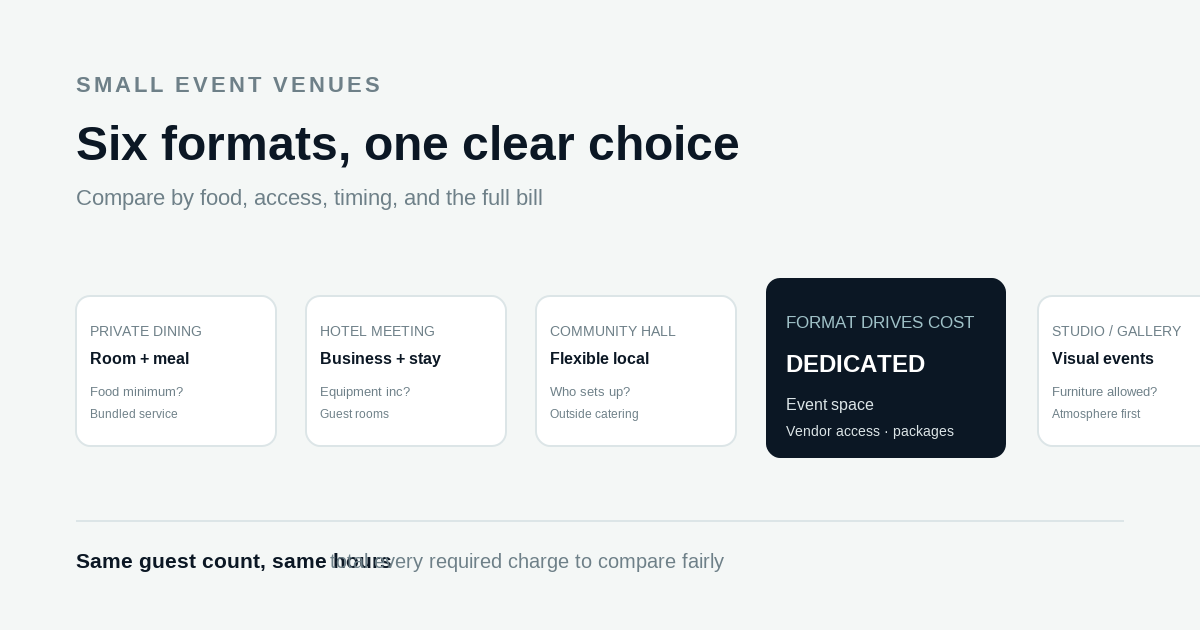
The best venues for small events fit the event's format, not merely its headcount. Compare private dining rooms, hotel meeting rooms, community halls, studios, coworking rooms and dedicated event spaces on privacy, food rules, accessibility, rental time and the full bill before choosing.
This comparison is for a birthday, shower, workshop, memorial, club dinner or business gathering that does not need an arena-sized room. Prices vary by city and date, so the worked example uses clearly labeled assumptions rather than pretending to quote a local venue.
Which small-event venue formats should you compare?
Six venue formats cover most small-event shortlists, and each shifts work between the host and the venue. A private dining room bundles food and service. A hotel meeting room adds business amenities. A community hall offers flexibility. A studio emphasizes atmosphere. A coworking room fits structured daytime sessions. A dedicated event space is designed around rentals and vendor access.
| Format | Usually strongest for | Question to ask first |
|---|---|---|
| Private dining room | Hosted meals | Is there a food minimum? |
| Hotel meeting room | Training and business | What equipment is included? |
| Community hall | Flexible local gatherings | Who handles setup and cleanup? |
| Studio or gallery | Visual, standing events | Are food and furniture allowed? |
| Coworking room | Daytime workshops | Can guests enter after hours? |
| Dedicated event space | Celebrations with vendors | Which vendors and fees are required? |
When is a private dining room the best choice?
A private dining room fits an event centered on a meal with limited setup. Food, tables, service and cleanup may sit on one bill, which reduces vendor coordination. Ask whether the room is fully enclosed, how the minimum spend works and whether tax, service charges or gratuity are separate.
A restaurant minimum is not the same as a room fee. Compare the final estimated bill for your guest count and menu. Confirm how allergies, outside cake, speeches and separate checks are handled in writing.
When does a hotel meeting room make sense?
A hotel meeting room suits a workshop, board meeting or family event with out-of-town guests. Wi-Fi, screens, catering and guest rooms may be available from one property. The tradeoff is a more detailed bill and possible minimums.
Ask for the room rental, food and beverage minimum, equipment, internet, parking, service charge, tax and overtime terms as separate lines. A low room fee can be a poor comparison if required equipment doubles the total.
What makes a community hall a practical option?
A community hall works when the host wants schedule and vendor flexibility and can manage more setup. It may allow outside catering, decorations and a longer access window. The host may also be responsible for tables, linens, trash and returning the room to its original condition.
Inspect the kitchen, loading path, restrooms, sound limits and cleanup checklist. Our small-hall booking guide explains the operational side from the venue's perspective, including holds, invoices and access details.
Who should choose a studio or gallery?
A studio or gallery suits a reception, launch or creative gathering where the room itself sets the tone. Open layouts can adapt to standing or seated plans, but the published capacity may change with furniture and event use.
Ask whether art or equipment remains in place, which walls can be used, whether candles and amplified sound are allowed, and what insurance vendors must carry. Photograph the agreed floor plan and attach it to the booking documents.
When is a coworking meeting room enough?
A coworking room is often enough for a daytime class, interview day or planning session. It can offer a screen, whiteboard and reliable internet without celebration-specific services. Evening entry, alcohol, music and public guest access may be restricted.
Confirm reception hours, building entry for every attendee and the time when the room must be empty. A two-hour booking can feel short once 20 minutes of arrival and 20 minutes of pack-out are included.
Why choose a dedicated small event space?
A dedicated event space fits a celebration that needs vendor access, an event layout and a formal booking process. The venue may offer packages, bar service, furniture, coordination and milestone payments. That convenience needs a line-by-line comparison.
Read the proposal, contract and invoice as different documents. Venue operators can use a banquet event order template to record setup and service details, while the customer contract and bill establish obligations and money.
How should accessibility affect the comparison?
Accessibility should be verified through the actual guest route, seating and facilities, not a single "accessible" label. Check arrival, parking or drop-off, entrances, interior routes, restrooms, seating choices and emergency procedures for the event's setup.
For ticketed events with assigned seats, the U.S. Department of Justice says accessible tickets must be sold in the same manner and under the same conditions as other ticket sales. It also says accessible seating information should provide the same level of detail as information for other seats. That federal guidance is authoritative for ADA requirements, but local rules and the facts of a particular facility still need qualified review.
How do you compare the real cost of small-event venues?
Compare every required charge for the same guest count, hours and service level. A useful quote separates the room from optional spaces, per-person rentals and staff time so another venue can be priced on the same scope.
VenueBill's tracked sample invoice supplies a reproducible fictional line-item example. Its source lists tables and chairs with a quantity of 120 and a rate of $10, so the product is 120 × $10 = $1,200 for that line. The same source also contains a $4,500 venue-rental line, a $900 ceremony-space line and 6 coordination hours at $50 each, but those wedding-invoice figures are not local market quotes.
| Sample line | Source inputs | Calculated amount |
|---|---|---|
| Tables and chairs | 120 × $10 | $1,200 |
This calculation shows only how a quantity and rate produce one invoice line. It is not a small-event price benchmark, a full quote, or a claim that a 120-person wedding is a small event. To compare a 40-person gathering, replace the sample quantity and rate with each venue's written quote, remove services the event does not need and keep the same rows across candidates. Keep refundable deposits outside the expense subtotal and list when cash is due. Our guide to milestone payments for event venues shows how a venue can divide a balance by dates without confusing planned installments with recorded payment.
What should you verify before signing?
A small-event booking should be verified with one written scope covering the room, time and bill. Walk through these items with the person who can amend the agreement:
- Approved event use and guest count
- Exact access, event and cleanup times
- Included rooms, furniture and equipment
- Food, alcohol and vendor restrictions
- Accessible guest route and seating plan
- Noise, decoration and cleanup rules
- All required charges, deposits and due dates
- Cancellation, date-change and overtime terms
Do not rely on a tour conversation for a material promise. Put the agreed item into the proposal or contract, then confirm that the invoice matches it.
Frequently asked questions about venues for small events
Frequently Asked Questions
Quick answers to the questions readers ask most about this topic.
What types of venues are best for small events?
How many guests count as a small event?
How do I compare venue prices fairly?
What should I ask during a small venue tour?
Put your next booking on a payment schedule
Keep the couple, event date, deposit, contract, and final balance together. Create your account, set up your venue, and start with one event.
Card required to start. Cancel anytime in the first 14 days and pay nothing; Pro is $39/month after the 14-day trial unless canceled.